
“Why Did I do that?” Understanding How We Respond to Trauma
Written by: Allyson Inez Ford, MA, LPCC | Founder of ED & OCD Therapy

“I didn’t say no, so it’s my fault too, right?”
This is a common question I get as a therapist who often works with trauma. So many of us blame ourselves for the bad things that have happened to us. Self-blame can be a way to feel like we have some control over something that was very scary and out of our control. It goes something like this: “If I can convince myself that I caused it, maybe I can convince myself that I could have prevented it and can prevent it from happening again.”
The downside of this kind of thinking (other than that it is not true) is that it can also become a recipe for shame, self-disgust and self-hatred. Part of healing from trauma is understanding how our bodyminds respond to experiences that feel threatening, overwhelming or unsafe. Learning about the different trauma responses can help you develop insight into how you personally adapted to what happened to you.
Our Bodies respond to danger before we have consciously decided what to do
Sometimes we fight. Sometimes we run. Sometimes we freeze. Sometimes we try to keep the other person happy or prevent them from becoming more dangerous. These responses are adaptations, they are ways our bodies and minds attempt to protect us. When you understand that your nervous system can respond to trauma in ways that are outside of your conscious control, it becomes possible to loosen some of the blame and shame you may have been carrying. You can also begin to understand what your body was trying to do for you in that moment.
This can be especially important for survivors of sexual trauma where there is an added layer of stigma, judgement and societal expectations around how victims should respond (lest a survivor be “faking it”).
If you’ve experienced sexual assault you may wonder:
Why didn't I fight them? Why didn't I leave? Why did I go along with it? Why did I laugh? Why didn't I tell anyone? Why did I keep going back? Why didn't I say no?
These questions can feel like evidence that you somehow participated in or caused what happened. In trauma therapy, we talk a lot about how these are actually universal responses and are certainly not consent or cause for the harm that was perpetrated.
The Window of Tolerance
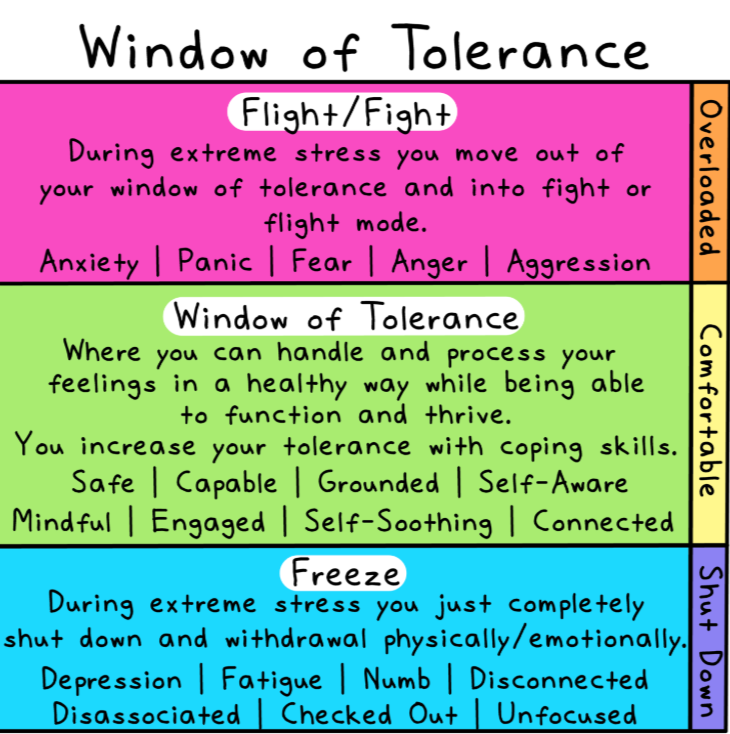
Before we dive into the different types of trauma responses, it’s important to understand the window of tolerance.
The window of tolerance is a concept used to describe the range of nervous system arousal where we are able to remain relatively grounded, present and able to think and respond intentionally.
When we are within our window of tolerance, we generally have greater access to our ability to reflect, communicate, make decisions, feel, notice what we need and respond to what is happening around us.
Trauma pushes us outside of our window of tolerance, into states of either (or both) of hyperarousal (or overloaded) or hypoarousal (or shut down).
(creator of the visual to the right @blessingsmanifesting)
Hyperarousal vs. hypoarousal
When we become hyper-aroused, our nervous system is activated and we may experience intense anxiety, panic, anger, agitation, racing thoughts or a urgency to act immediately by fighting back or fleeing the situation.
When we become hypo-aroused, our nervous system may move toward shutdown. We may feel numb, disconnected, exhausted, foggy, detached from our body and unable to respond. People often characterize this state as “freeze” and it is particularly common if you were in a situation that you felt trapped in- other times its forced by being drugged or restrained somehow.
These responses exist on a spectrum, and people can move between them. You may feel panicked one moment and completely numb the next. You may want to run while simultaneously feeling unable to move. And if you have a dissociative disorder, you may have some parts in freeze and others anxious and on edge, all at the same time. In fact, the way trauma is experienced by those with dissociative disorders (such as DID or OSDD) can look and feel very different. Because of that, many people with DID or OSDD may prefer the wheel of tolerance, which is a less linear looking model of how traumatic responses might show up in a person (credit to Katarina Lundgren for creating this alternative model).
Whether its the wheel of tolerance or window of tolerance that resonates more with your experience, having a visual can help you process and understand how you have been impacted. In addition, both of these models encompass the most common trauma responses, listed in more detail below.
Four Of the Most Common Trauma Responses
There are four trauma responses that are commonly discussed in trauma therapy: fight, flight, freeze and fawn. These are different ways the nervous system may attempt to respond to perceived danger. Even after the trauma has passed, these responses often show up when something in the here and now triggers our past trauma- the smell of a candle, the tone of a voice, a nightmare, a memory that pops up or even just a single word.
-
The fight response involves moving toward danger in an attempt to protect yourself. This can look like anger, yelling, arguing, pushing someone away, becoming defensive or physically fighting back. It can also show up in less obvious ways, such as becoming highly controlling, argumentative or intensely focused on proving yourself right.
Some people feel shame about their fight response because they remember being angry or aggressive during a traumatic experience- or they may feel unable to control their reaction to things and experiences in the here and now, causing issues in their current relationships.
You may think:
Did I make things worse by lashing out?
Did I hurt them, too?
Maybe I am just like my abuser.
In reality, your bodymind was attempting to create safety by pushing back against a perceived threat- you were trying to protect yourself. Of course, if this reaction keeps showing up in your life and the trauma is in the past, working on the automatic urge to fight when you feel threatened can greatly improve your relationships and is apart of healing from trauma.
-
The flight response involves trying to escape or get away from danger. This can look like physically leaving a situation, avoiding someone, constantly staying busy or feeling an intense need to get away when conflict or discomfort arises.
Flight can also show up in daily life long after the traumatic incident occurred. For example you might become extremely productive, perfectionistic, achievement-oriented, you may over-exercise, in essence- you are likely over-functioning. Staying busy can become a way of avoiding difficult emotions or sensations that feel unsafe to experience. These emotions and sensations might be louder when there is nothing to immediately focus on, which is why many trauma survivors find themselves with an over-packed schedule despite feeling exhausted and in over their heads with the amount of obligations they take on.
For someone with a strong flight response, slowing down may actually feel threatening. Learning to rest, in small doses and in a safe environment, can help rewire your nervous system to learn rest can be safe and restorative.
-
The freeze response involves becoming immobilized or unable to respond in the way you might expect yourself to. You might feel physically unable to move, speak, fight or leave. You may experience numbness, dissociation, feeling detached from your body, have a hard time thinking clearly or a sense that you are watching what is happening from outside yourself.
Freeze is particularly important to understand in the context of sexual trauma because survivors often blame themselves for not fighting back or saying no. However, when freeze takes over, it is not possible to say no. Your body senses that what you are experiences is unescapable, or that you will be hurt more if you resist, so it shuts down the ability to move, talk or be fully present.
This is particularly present in people with DID, OSDD or PTSD with the dissociation sub-type. It’s a brilliant survival skill, even though it can feel really confusing afterwards.
-
The fawn response involves attempting to create safety by appeasing, accommodating or meeting the needs of another person. You may become highly attuned to other people's emotions and quickly notice changes in their mood. You may apologize frequently, have difficulty saying no, prioritize other people's needs over your own or feel responsible for keeping everyone around you happy. Sometimes, in cases of repeated abuse, survivors may even initiate the abuse to get it over with, when they know it is inevitable anyways. They may sense that it won’t be as brutal if they act “good.” This is nothing to be ashamed of, and this does not mean it was your fault or that you wanted it- absolutely NOT.
You may have smiled or been agreeable.
You may have tried to make the other person happy.
You may have comforted the person who was hurting you.
You may have gone along with something because you believed that resisting would make the situation more dangerous.
Your behavior in those moments needs to be understood within the context of what your body perceived as the safest available option at the time and given the circumstances.
You Probably Have More than One Trauma Response
It is easy to read about fight, flight, freeze and fawn and start wondering, “Okay, so which one am I?”
However most people do not fit neatly into one category. You might fight in one situation, freeze in another and fawn in a relationship where you feel especially afraid of rejection or conflict. You may also move through several responses during the same traumatic experience.
For example, you might initially freeze, then begin fawning in an attempt to make the situation safer and later experience a strong flight response once you have an opportunity to get away. Trauma responses are shaped by the context, the relationship, the type of threat, your previous experiences, the power dynamics and access to resources that would help you leave.
There is not a right or wrong way to respond to trauma, however you survived deserves to be appreciated and held with compassion- not judgement. This is one of the most common things that I help trauma survivors process in therapy. And we usually have to process it many, many times.
What About “Why Didn't I Just Leave?”
This is one of the most painful questions trauma survivors can ask themselves and it breaks my heart when I hear this from clients. Yet, as a trauma survivor myself, I have found my brain fixated on this question, too.
Leaving may seem obvious when you look back at an experience from a place of safety. You have information now that you may not have had then. You may understand the situation differently and you likely have more resources, distance, support and awareness.
During the experience itself, your body was responding to what it perceived as available in that moment, this is especially important when trauma happens within a relationship.
If the person harming you was also someone you depended on, loved, feared losing or needed for safety or stability, your bodymind had to navigate a much more complicated situation than simply deciding whether to stay or leave. If this is you, I am sending you so much compassion- there are few things more painful than realizing those who were supposed to love and protect you, chose to hurt and exploit you instead. I want you to know that this is a reflection of them, not you.
Trauma Responses Are Adaptations, Not Proof of being a Failure
Many trauma survivors eventually turn their trauma responses into judgments about who they are. You may tell yourself that you’re week or you’re a coward. That you’re too sensitive, too much of a people pleaser. You might feel like there is something fundementally wrong with you. It doesn’t help that these narratives are echoed in the patriarchal, power hungry and exploitative society we live in.
These core beliefs are something that can be worked through in trauma therapy. While we can’t change what happened, or change how the memories feel, we can learn to relate to the experience differently.
A trauma response is a natural adaption to danger. It can continue showing up long after the original danger has passed because the body does not simply forget what it has learned even if you feel disconnected from the conscious awareness of the experience. While it is tortuous, I often find that people’s symptoms show up when they are in a safer stage of life, and when the trauma is ready to be healed and known. Unfortunately, we don’t get to choose when this happens, and it can be completely devastating and life altering when it does.
Curiosity about your Trauma Responses can pave the Way for self-compassion and healing.
Instead of asking, What is wrong with me? Start asking:
What is my bodymind trying to protect me from?
When did I learn that this response was necessary?
What situations tend to activate this response?
What do I need in order to feel safer now?
These questions can bring up a lot- many people need the support of a skilled trauma therapist or safe attachment figure to begin exploring these questions.
Trauma & Your Relationship to Your Body
Trauma can fundamentally change the way you experience your own body.
You may feel angry at your body for freezing. You may feel ashamed of your body for responding in a way you did not understand. You may feel disconnected from your physical sensations because being present in your body once felt unsafe. This is one common reason why eating disorders develop, because we blame our body and believe if we can “fix” it, we can redeem ourselves or prevent it from happening again.
But your body was responding to what it perceived as danger using the tools it had available, not betraying you. Healing does not require you to love every part of your body or feel completely comfortable in it all the time. It can begin with developing a little more curiosity about your physical sensations, recognizing when your nervous system is activated and learning what helps you return to a greater sense of safety.
Over time, you can begin to build a relationship with your body that is based less on judgment and more on understanding, self compassion and care. This is the bread and butter of trauma therapy, so to speak.

Trauma Therapy Can Help You Heal
Understanding trauma responses is one piece of trauma recovery. Therapy can also help you process what happened, develop greater awareness of your nervous system, work through shame and self-blame and build new ways of responding when your body detects danger.
Trauma therapy can involve exploring the experiences that shaped your responses while also paying attention to what is happening in your body and relationships in the present.
You deserve the opportunity to understand your survival responses without using them as evidence against yourself. If you are looking for trauma therapy in San Diego or throughout California, via telehealth, reach out to schedule a free 15-minute consultation. We can talk about what you are experiencing and whether therapy might be a good fit for you.
