
Nourishment as Defiance: How Activism Strengthens Eating Disorder Recovery
Written by: Allyson Inez Ford, LPCC, Founder of ED & OCD Therapy
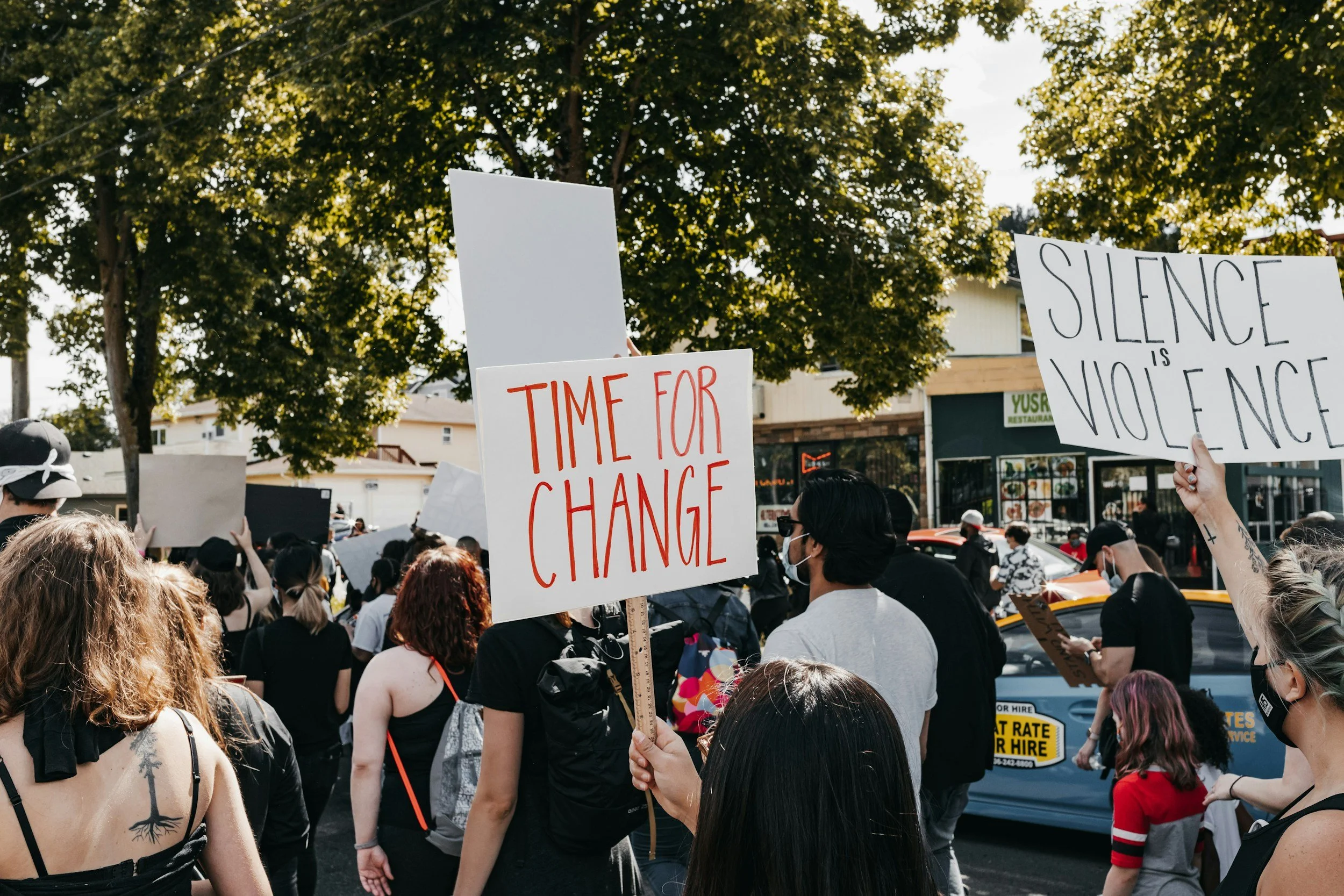
Recovery from an eating disorder is often framed as an individual journey- a private battle and personal healing process. And while it is absolutely personal, what gets missed in mainstream narratives of recovery is that it is also a collective process in the pursuit of liberation. This becomes clearer when we understand that eating disorders are social justice issues. The way we relate to our body and the bodies of others is inextricably tied to systems of oppression such as sexism, racism, anti-fat bias, ableism and cisheterosexism.
A little of My Own Journey
In my own recovery journey, this became clear when I started unpacking why I felt so bad in my body, why it never felt “good enough.” I was lucky to have a feminist therapist who strategically pointed out how my relationship to my body mirrored the societal messaging of the weight obsessed culture we live in. She challenged me to think about the messages I internalized about body sizes, beauty and self worth as a female identifying person. Once she lifted this veil for me, I couldn’t un-see it. And I also couldn’t stay quiet about it. At the same time, I started graduate school and the very first class I took, on social identities, had an entire section on Health at Every Size. For 2015, this was pretty radical, and it fired me up.
Channeling Rage into Action
I fueled my newfound rage into activism, writing letters to corporations such as Target- urging them to stop using photoshop in their ads. I made it my mission to call out injustice when I see it, rather than internalizing the messages and blaming my body. In this way, activism fueled my recovery. My “why” for recovery became connected to not just my own self, but everyone else impacted by diet culture and oppressive messaging about bodies. This kept me motivated to keep fighting and challenging my eating disorder, as I refused to comply with a system so far from my true values.
And now, as a therapist myself, I talk with my clients all the time about the importance of using your voice and questioning the lies we have been sold. I see this as essential to both personal and collective well-being. Eating disorders take away our voice, they disconnect us from our authentic selves, our values. For example, in the beginning of my own eating disorder, I followed every “rule” society handed me about bodies. I believed that shrinking myself would make me worthy, safe, lovable. I listened to fitness instructors, health magazines, diet culture- literally everyone but myself. I ignored the signals my body was sending me about rest and nourishment. I disregarded my hunger as something to be controlled and feared. In doing so, I also silenced my emotions, critical thinking and ability to reflect. Not because I was cognitively incapable, but because my mind was SO consumed with food that I had little mental space to think about anything else.
I was the smallest I had ever been, but I was also the most miserable. Life wasn’t magically better after shrinking myself, it was actually worse. I felt like a shell of my real self- I wasn’t driven by passions and interests anymore and life felt “grey” instead of colorful.
Healing required something basic but also transformational for the world we live in: learning to trust my own voice again.
Colonialism and Food Morality
If we zoom out, we see that eating disorders are not simply about food or weight. They are deeply entangled with racism, sexism, capitalism, cisheteronormativity, classism, and ableism.
During colonization, European settlers moralized bodies and food. Indigenous foods were labeled “bad” or “savage.” Larger bodies were framed as sinful or undisciplined. These narratives justified genocide, enslavement and the policing of bodies. Anti-fat bias and food moralization have roots in white supremacy and patriarchal control (Strings, 2019).
The morality of food (“good vs. bad”), did not arise from science, it came from power and a desire to exert control over others.
That legacy continues today, in fact, it's more rampant than ever before and I suspect that is why we are seeing record high rates of eating disorders. It seems like everywhere we turn, someone is talking about weight loss drugs or the latest “wellness” culture trend that really boils down to restrictions and food rules.
The diet industry is worth over $90 billion in the U.S. alone (as of 2023, likely more now). It knowingly promotes diets that fail long term, because repeat customers sustain profit. Research consistently shows that the vast majority of diets result in weight regain within 2–5 years (Mann et al., 2007). Yet the cycle continues, framed under the guise of “health.”
Meanwhile:
Doctors are less likely to assess eating disorders in BIPOC patients, even though Black women are at higher risk for bulimia (Marques et al., 2011).
ED treatments are largely normed on white, thin populations.
Food insecurity, which disproportionately affects BIPOC communities, is linked to higher rates of binge eating and disordered eating behaviors (Becker et al., 2017).
Eating disorders remain among the deadliest mental health diagnoses.
And diet/wellness culture is profoundly ableist, equating “health” with worth, ignoring genetics, disability, chronic illness, and the social determinants of health.
When clients begin to understand this, I see them shift. The shame inside softens and the anger extends outwards instead of inwards. Because if the problem is systemic, it was never a personal moral failure. Caveat: this awareness alone is not likely to make anyone magically recover, it is simply part of what can motivate some folks- particularly those with a strong sense of justice!
How Activism Can Strengthen Recovery
Recovery is about reclaiming agency (and no, your eating disorder won’t ever provide you the kind of agency that is actually fulfilling, it offers a temporary sense of control, until it ends up controlling you), reclaiming your voice and living according to your values. Justice tends to be a strong value of many of the people with eating disorders I work with, I suspect this is due to the high degree of sensitivity and empathy that many people with eating disorders have. This sensitivity towards justice often fuels activism, and thus, one’s eating disorder recovery becomes vital to collective liberation. This adds meaning and purpose to one’s recovery that surpasses personal well-being. In other words, the fight to heal becomes political, not just personal.
1. Activism Restores Agency
Eating disorders thrive in silence and isolation. Activism invites connection and self expression.
Research on collective action shows that engaging in social justice movements increases feelings of empowerment, self-efficacy and meaning (van Zomeren et al., 2012). These are the very qualities recovery requires.
When someone moves from “my body is the problem” to “I live in a system that harms bodies and profits off of me hating mine” - motivation often increases. Recovery becomes about resistance and refusal to comply with oppression.
This seemingly simple reframe can dramatically increase willingness to nourish oneself.
2. Activism Builds Community
Recovery is relational. Social identity theory suggests that identifying with a group engaged in shared values increases resilience and psychological well-being (Haslam et al., 2009). Activist communities provide belonging that is not contingent on body size, but rather based on shared values and internal qualities of the self.
For many clients, especially those marginalized by race, gender identity, size or disability, finding spaces that affirm who they are on the inside reduces the lifelong pain of being externally defined and othered. Community that accepts you for who you truly are, counters isolation and shame. And since isolation fuels eating disorders, the community that activism creates ends up serving as a protective factor.
3. Activism Reconnects Us to Values
Acceptance and Commitment Therapy (ACT) research consistently shows that living in alignment with personal values increases psychological flexibility and decreases experiential avoidance, a core process in eating disorders (Juarascio et al., 2013).
When someone identifies liberation, equity, justice or community care as core values, recovery behaviors (like eating consistently, resting, rejecting diet culture) become value-aligned acts. Taking up space becomes resistance and feels purposeful, rather than an empty but marketable slogan.
4. Activism Reduces Shame
Shame is one of the most powerful maintaining factors in eating disorders.
Understanding the historical and systemic roots of body oppression reduces self-blame. And when self-blame decreases, we create a softer space inside for compassion. Compassion is one of the strongest predictors of recovery progress (Kelly & Carter, 2015).
When someone realizes:
“My eating disorder didn’t come from weakness. It came from trying to survive a harmful system set up to harm me.”
That insight can be so powerful it lends to self forgiveness, self compassion and ultimately, compassion for all others. While these things don’t instantly cure disordered eating, they do have the power to create a strong foundation to begin exploring healing oriented behavior challenges (like eating a fear food or letting go of counting calories)
Using Your Voice as Part of Healing
In my own recovery, I had to learn to trust that my voice mattered by experimenting with using it. Not just in therapy rooms, but also in the world. As scary as this can be, doing so helps build confidence, integrity and commitment to our values.
For many of my clients, activism does not look like protesting in the streets. It might look like:
Unfollowing diet promoting and ‘thinspiration’ social media accounts.
Calling out weight stigma in a doctor’s office.
Refusing to participate in body-shaming conversations.
Supporting food justice initiatives.
Advocating for inclusive mental health policies.
Using your voice strengthens recovery because it strengthens your identity.
When we reconnect to who we are- our values, our communities, our culture- the eating disorder loses its grip.
Recovery Is Both Personal and Collective
Eating disorder recovery will always involve the deeply personal work of nourishment, therapy and emotional healing. But it does not end there because eating disorders are not simply individual pathologies. They are shaped by the systems around us.
When we engage in activism, even in small ways, we are not only healing ourselves but we are interrupting the systems that create harm in the first place.
Like Mariame Kaba says, none of us are free until all of us are free.
And so, recovery itself is an act of resistance.

Reflection Questions:
If you are in recovery, consider journaling about these questions:
Where have I been taught to stay quiet?
What systems benefit from my body hatred?
What would it mean to nourish myself as an act of defiance?
Remember: Your voice does not have to be loud to matter, but when you begin using it, you make space for others to do the same.
At ED & OCD Therapy, We believe in you and are rooting for you!
If this resonates with you and you are looking for a therapist, we’d love to support you! Please reach out to schedule a free 15 minute consultation call to learn more about our approach and services.
References:
Becker, C. B., Middlemass, K., Taylor, B., Johnson, C., & Gomez, F. (2017). Food insecurity and eating disorder pathology. International Journal of Eating Disorders, 50(9), 1031–1040.
Haslam, S. A., Jetten, J., Postmes, T., & Haslam, C. (2009). Social identity, health and well-being: An emerging agenda for applied psychology. Applied Psychology: An International Review, 58(1), 1–23.
Kelly, A. C., & Carter, J. C. (2015). Self-compassion training for binge eating disorder: A pilot randomized controlled trial. Psychology and Psychotherapy: Theory, Research and Practice, 88(3), 285–303.
Marques, L., Alegria, M., Becker, A. E., Chen, C., Fang, A., Chosak, A., & Diniz, J. B. (2011). Comparative prevalence, correlates of impairment, and service utilization for eating disorders across U.S. ethnic groups. International Journal of Eating Disorders, 44(5), 412–420.
Puhl, R. M., & Suh, Y. (2015). Stigma and eating and weight disorders. Current Psychiatry Reports, 17(3), 552.
Strings, S. (2019). Fearing the Black Body: The racial origins of fat phobia. New York University Press.
van Zomeren, M., Postmes, T., & Spears, R. (2012). On conviction’s collective consequences: Integrating moral conviction with the social identity model of collective action. British Journal of Social Psychology, 51(1), 52–71.
