
ERP VS. I-CBT: What’s The Right OCD Treatment for You?
Written by: Allyson Inez Ford, MA, LPCC | Founder of ED & OCD Therapy
Recovering from OCD is a tough journey
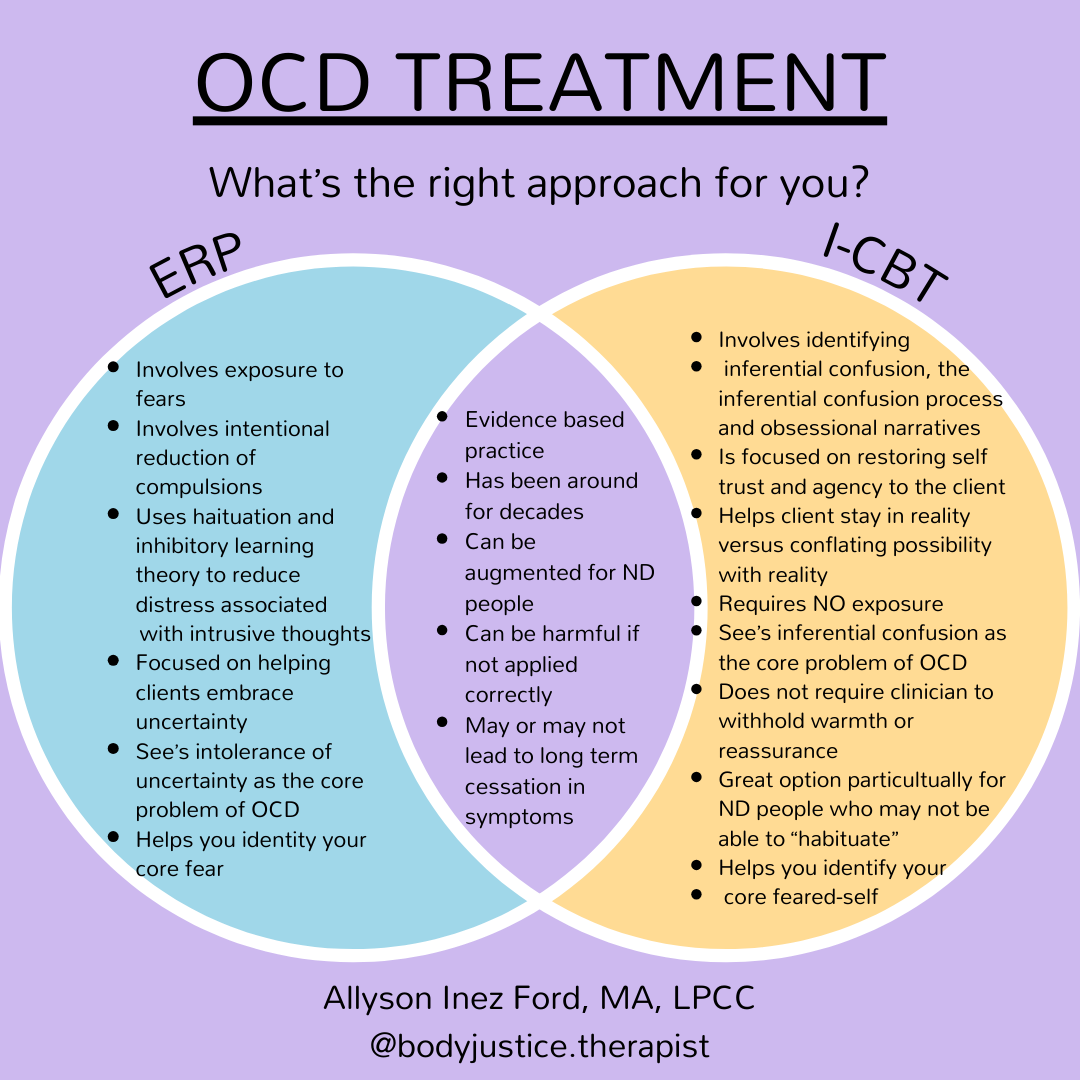
Letting go of safety behaviors (compulsions) and facing your fears (exposures) can truly feel like jumping off a cliff. As someone who has been through OCD recovery personally and now helps clients recover from OCD as a specialized therapist- I am passionate about empowering OCD sufferers to choose the best treatment approach for them. ERP has been touted as the gold standard in care, and while it is very effective for many, it isn’t effective or accessible for everyone. I-CBT is another well-researched treatment for OCD, and the purpose of this post is to compare the two treatments so you can decide what one resonates best for you.
I-CBT has been around since the 1970’s and is highly effective in treating OCD, panic and other anxiety based conditions. It is starting to gain popularity in the mainstream OCD field, and we are proud to offer this approach at ED & OCD Therapy. Both Allyson and Parisa are trained in ERP and I-CBT and can walk you through this approach. Here are some key differences compared to ERP:
Understanding Inference Based- Cognitive Behavioral Therapy (I-CBT)
The I-CBT approach is about resolving inferential confusion (or obsessional doubt), identifying obsessional narratives, learning about the reasoning tricks of OCD and exploring how your ‘feared possible self’ influences the types of OCD you are vulnerable to.
I-CBT sees inferential confusion as the core problem of OCD and aims to help clients differentiate between reality and imagined possibility- using your five senses and values to ground you in what you already know. One of the key benefits of I-CBT is its focus on restoring self-trust and agency to the client.
I-CBT is a great option for neurodivergent people who may not be able to habituate to anxiety the same way neurotypical brains do- or for those that simply like understanding the “why” behind their struggle. I-CBT helps people identify their feared-self, building self-awareness and resilience against future OCD themes taking over.
Another key advantage of I-CBT is that it requires no exposure. This means the client is not required to confront or expose themselves to their fears or compulsions directly, which is understandably appealing to a lot of people struggling with OCD.
Exposure and Response Prevention Therapy (ERP)
On the other hand, ERP involves exposure to fears and intentional reduction of compulsions. It utilizes habituation and inhibitory learning theory to reduce the distress associated with intrusive thoughts. ERP is focused on helping clients embrace uncertainty, seeing intolerance of uncertainty as the core problem of OCD.
ERP is an evidence-based practice that has been around for decades. It helps you identify your core fear, which can be a critical step towards overcoming the disorder. Additionally, ERP can be augmented for neurodivergent people, since habitation isn’t necessary for a reduction in OCD symptoms.
In conclusion, both I-CBT and ERP offer effective strategies for managing OCD. Both have helped me immensely! Choosing the right approach depends on your specific needs, preferences and circumstances. It’s essential to consult with a specialized OCD therapist to determine the most suitable framework for you. At ED & OCD Therapy San Diego, we can help you explore what that might look like for you.
Overcoming OCD is a journey, and you’re incredibly brave for even considering facing this! If you’re ready to find healing from the pain of OCD, contact us and see how we can help you. We offer OCD therapy to California, Florida, Maryland, Tennessee, Utah and Washington State residents.
Find more about our approach via our other blog posts or our founder’s Instagram: @bodyjustice.therapist

Reach out to learn more about OCD Therapy
At Eating Disorder OCD Therapy, we offer compassionate, relational, and individualized care. We honor client autonomy, collaboration, and anti-oppressive, neurodivergent-affirming practices.
We provide therapy for Eating Disorders, OCD, Body Image, Trauma, Maternal Mental Health, and offer Ketamine Assisted Psychotherapy (KAP), Recovery Coaching (globally), and Clinical Consultation and Supervision for clinicians.
We are currently accepting new clients for in-person therapy in San Diego and virtual services in California, Florida, Maryland, Tennessee, Utah & Washington.
