
The Difference Between Body Dysmorphia and Body Image Struggles
Written by: Allyson Inez Ford, MA, LPCC | Founder, Psychotherapist & Clinical Supervisor at ED & OCD Therapy
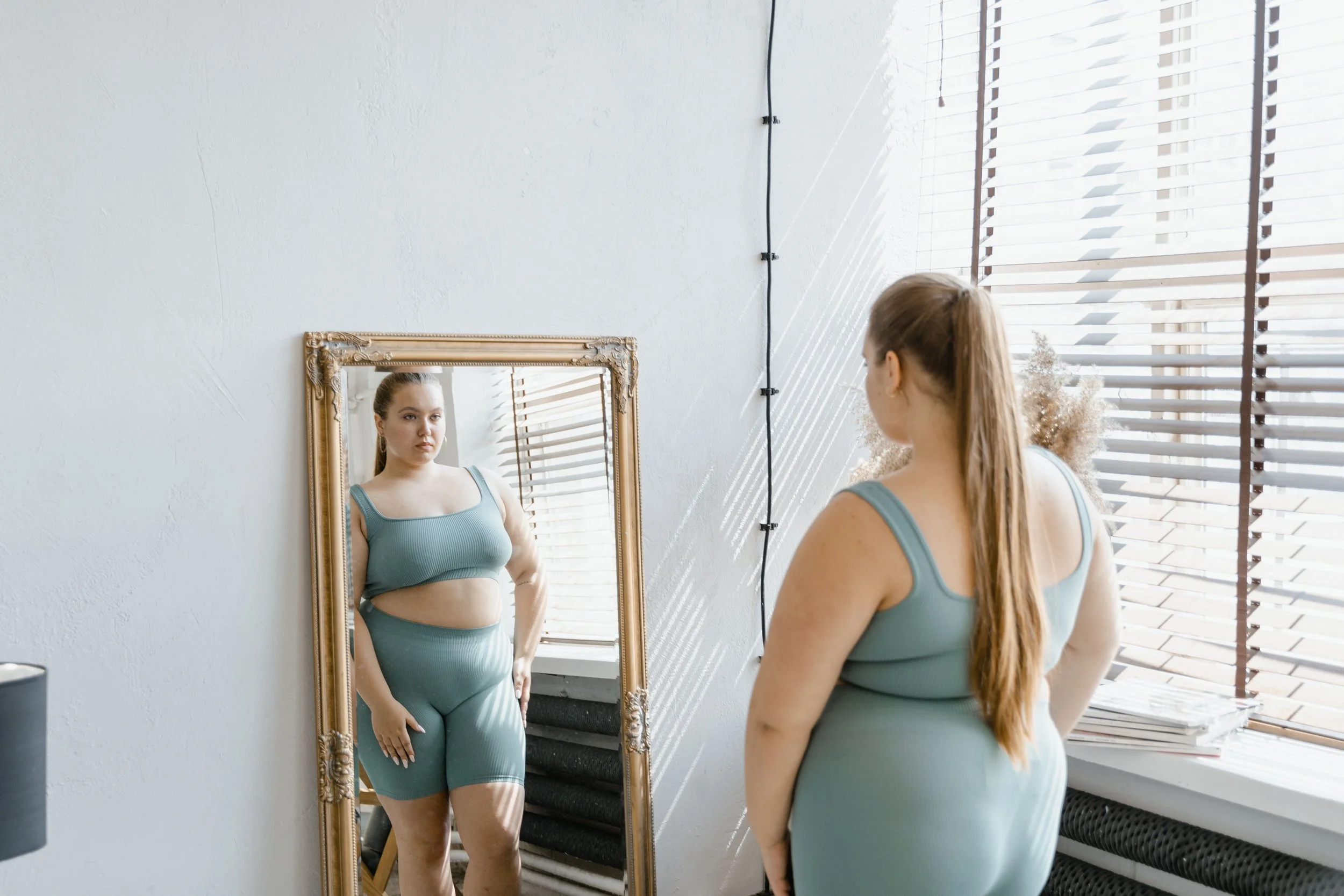
Most of us have had moments of standing in front of a mirror and not liking what we see. For some people, that discomfort is a passing visitor. For others, it feels like it takes up endless brain space to the point where it’s a constant fixation- like hours a day level of fixation.
Before I dive into what I mean here, let me be clear: this is not about who is more deserving of care or whose problems are more valid.
Any amount of body image distress is hard to live with and can turn into body dysmorphic disorder if left untreated.
However, after seeing how common the phrase ‘body dysmorphia’ is thrown around on social media, I felt compelled to discuss the clinical reality and highlight how serious this mental illness is. Social media can water it down and make it seem like a right of passage or quirky personality trait, and it is NOT that.
What is body image distress?
Body image distress refers to negative, uncomfortable and hyper-critical thoughts and feelings about one's body. It is incredibly common in today’s society that is increasingly appearance focused. Up to 40% of people experience negative body image at some point in their lives and that number makes sense when you consider the cultural environment we're all swimming in. Diet culture, anti-fat bias, the era of GLP-1s and SkinnyTok, racialized beauty standards, the obsession with youth and the relentless visibility of idealized bodies in media all contribute to how people feel about their own.
When I work with someone experiencing body image distress, their discomfort tends to center on overall body shape and size. They often have some awareness of where those feelings come from, whether it's a critical parent, a culture that equates thinness with worth or a lifetime of messages that their body is a problem to be solved. The thoughts, though very distressing, are often more redirectable. Exploring the systems behind the suffering can be genuinely therapeutic and that treatment tends to be shorter in duration. Again, I don’t mean to make this sound easy, it’s not. It’s really hard work.
Body image distress can absolutely be serious. It can fuel disordered eating, drive compulsive exercise, turn into BDD and cause significant emotional pain and isolation. Any amount of negative feelings towards your body warrants getting support, as it doesn’t typically go away on it’s own and is a risk factor for other mental health struggles.
Understanding Body Dysmorphic Disorder (BDD)
Body Dysmorphic Disorder (BDD) is a separate clinical condition, though it shares some features with body image distress. BDD involves an obsessive, often unrelenting focus on a perceived flaw in appearance, typically a specific body part rather than overall size or weight. We're talking about a nose, a patch of skin, hair texture, the symmetry of a face, the shape of an ear. Something that to others may appear minor or not noticeable at all, and yet to the person experiencing BDD feels enormous, urgent and undeniably present. Looking back on my own struggle with BDD, I feel like I was actually quite delusional in the way I was so fixated on my hair. What I perceived as “wrong” was actually not reality- and I can see that when I look back on photos now. When it was happening though, I truly thought everyone saw me the way I was seeing myself.
BDD, OCD and Intrusive Thoughts
BDD affects roughly 0.7 to 2.4% of the population- which means its actually quite rare and not as common as social media makes it seem. It is considered an OCD-spectrum disorder, which is important to ntoe because it shapes how we understand the maintaining mechanisms and how we treat it in therapy. The thoughts in BDD are not just negative- they are intrusive. They feel uncontrollable and feel very real. And they generate a cycle of compulsive behaviors that the person uses in an attempt to manage the anxiety, get certainty or fix the ‘perceived’ flaw. The obsessive-compulsive cycle in OCD applies to the cycle that fuels BDD too, and healing requires breaking that cycle by gradually reducing the appearance compulsions and reconnecting to behavior that aligns with your values.
Compulsions in BDD often look like:
Mirror checking or mirror avoidance
Taking and analyzing dozens of selfies
Seeking reassurance from others about their appearance
Researching or pursuing cosmetic procedures
Skin picking
Excessive grooming
Comparing the part(s) of your body you are fixated on to others
Changing clothes repeatedly
Mentally replaying social interactions to assess whether someone noticed the flaw
Avoiding social situations
Covering parts of the body despite the weather or other factors
Attempting to “compensate” for the perceived flaw by controlling other parts of your appearance
A Note on Cosmetic Procedures and BDD
Here is a truth that I want you to really sit with: cosmetic procedures do not resolve BDD. Surgical outcomes are rarely satisfying to someone with BDD, and in some cases the distress simply transfers to a new feature. Sadly, many people with BDD will get repeated surgical procedures, spending a lot of time and money trying to “fix” their appearance, only to never get the relief they are longing for. This is one of the clearest markers that what we are dealing with is related to the person’s perception of themselves and not an objective truth about their appearance.
People with BDD also tend to have lower insight than those experiencing general body image distress. They often have a harder time accessing the perspective that the belief might not be fully accurate. The thoughts feel like facts. This makes treatment more challenging and more specialized.
And the stakes are real. Up to 24% of people with BDD attempt suicide, indicating the seriousness of this mental health condition. It is not something to be brushed off as vanity, the pain is often much more deep rooted.
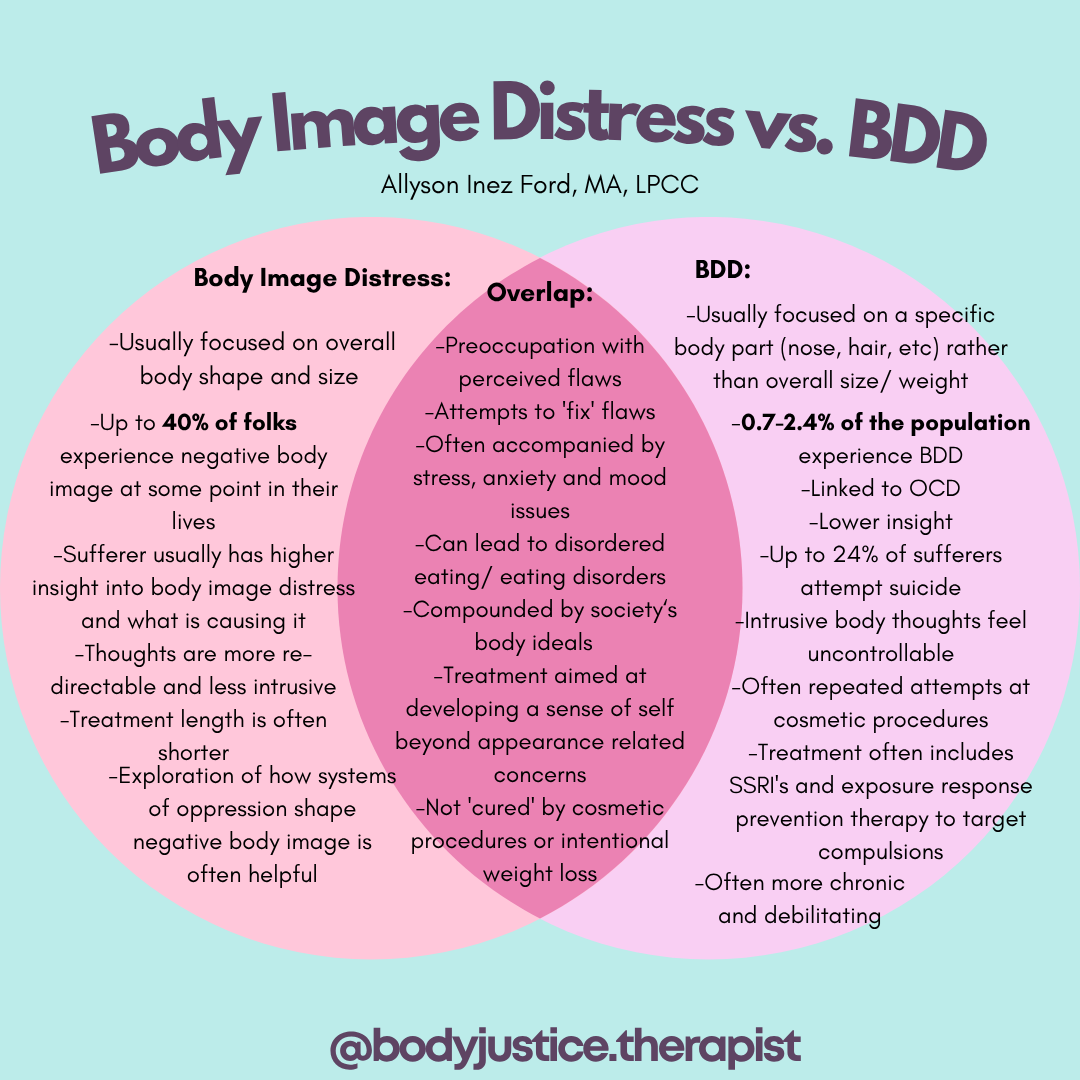
Where BDD and BOdy Image distress overlap
Even with those important distinctions, body image distress and BDD share meaningful common ground. I created this venn diagram as a visual a couple of years ago as a helpful overview.
Both BDD and body image distress involve preoccupation with perceived flaws. Both involve attempts to fix or address those flaws. Both are accompanied by stress, anxiety and mood difficulties. Both can lead to or coexist with disordered eating and eating disorders. Both are made worse by a culture that relentlessly evaluates and ranks bodies. And neither is "cured" by cosmetic procedures or intentional weight loss.
Treatment Differences
Treatment for both also shares a common north star: helping someone develop a sense of self that extends beyond appearance. What differs is the clinical pathway to get there.
For body image distress, treatment often involves helping clients map out their body image story: exploring the roots of their distress, including internalized messages, systemic oppression, difficult or traumatic experiences in their body, relational wounds and identity development. Weight-inclusive, psychodynamic, ACT, DBT and liberation-focused frameworks are often a natural fit.
For body dysmorphic disorder, treatment typically involves ERP (Exposure and Response Prevention) to target the compulsion cycle in addition to the above strategies. Sometimes a referral for psychiatry can be helpful with BDD too- SSRIs can be really helpful in addition to therapy. Without addressing the OCD-spectrum mechanics, people with BDD can spend years in talk therapy gaining insight but not moving the needle on the core distress.
THe Risk of misdiagnosis
Misdiagnosis is common. Body image distress and BDD can look similar on the surface, and if a clinician is only trained in one framework, it is easy to miss the other. Someone with BDD may be treated for an eating disorder without the OCD-spectrum piece ever being addressed. Someone with body image distress rooted in systemic oppression may receive OCD-model treatment that pathologizes a socially-rational response to living in a fatphobic world. Getting this right shapes the entire treatment approach.
What I hope you take from this is that body image suffering is real, it is treatable and there are clinicians who specialize in both of these presentations. Getting an accurate picture of what is driving your distress is the first step toward getting care that actually fits.

Looking for a Body Image or BDD Therapist near San Diego, CA?
If you're ready to understand your relationship with your body more deeply and find support that actually fits, we’d love to connect. Book a free 15-minute intro call with us to learn more about how we can help you heal from BDD or body image distress.
In addition to San Diego, we offer virtual therapy sessions to anyone in California, Washington, Utah, Tennessee, Maryland and Florida. We also provide recovery coaching services worldwide!
